The selected product is placed on prepared skin according to its exact protocol.
Apply · controlled action · shed · renew
How professional chemical peels work
A peel creates a controlled chemical injury at a selected depth. The treated surface exfoliates and regenerates—but the acid name or percentage alone does not tell you how deep the treatment will behave.
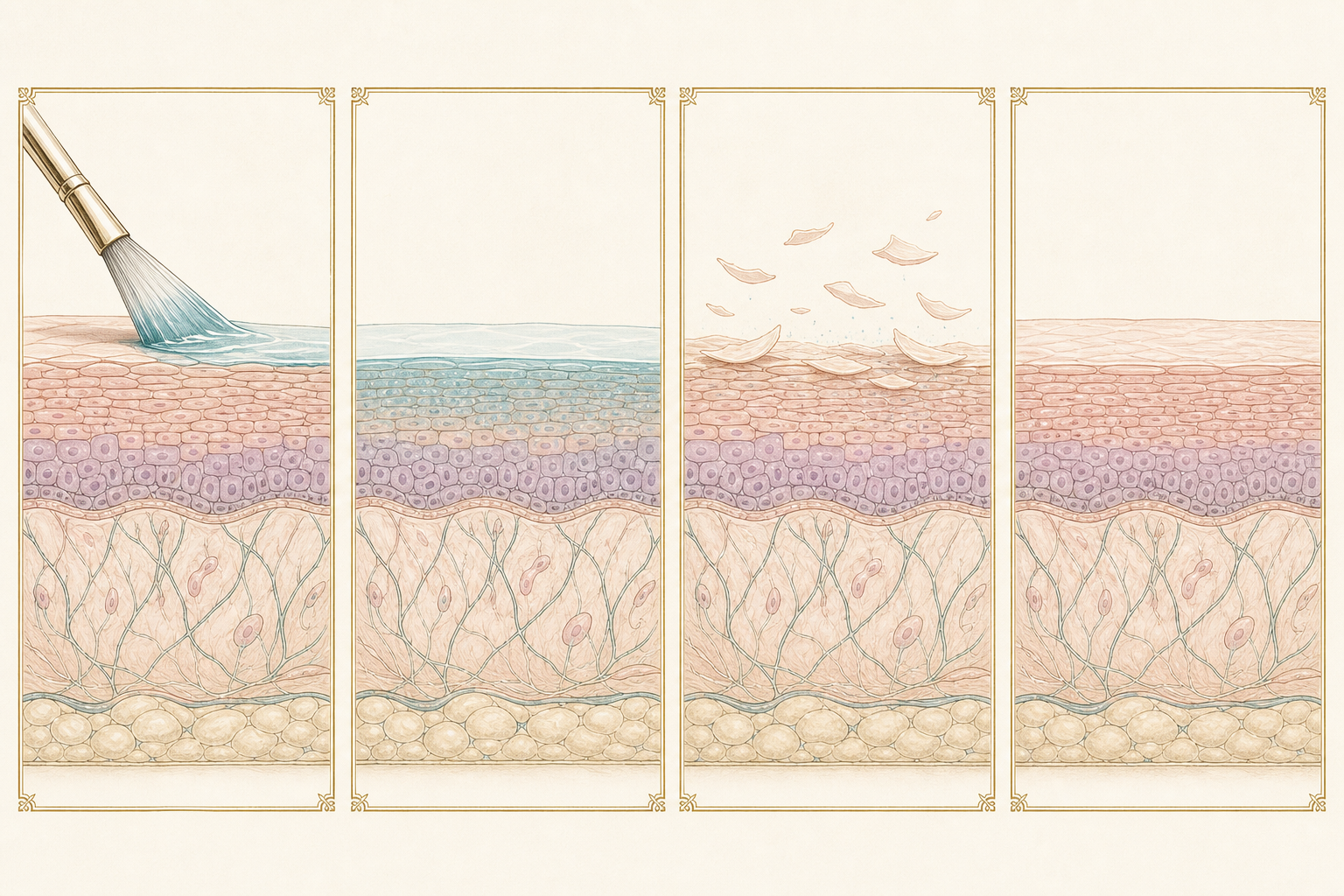
The formulation creates controlled activity through a planned level of the epidermis or dermis.
Surface cells loosen and may flake, although dramatic visible peeling is not required for every superficial peel.
The barrier recovers and newly organised surface cells replace those removed.
What controls peel depth?
Formulation
Acid identity, concentration, pH, vehicle and whether the product self-neutralises all matter.
Application
Number of layers, contact time, amount, pressure and neutralisation can change activity.
The skin
Thickness, oil, barrier condition, preparation, recent products, treatment site and previous procedures affect penetration.
The endpoint
Erythema, frosting or timing may guide a trained practitioner, but endpoints differ between acids and products.
Four acids, different behaviour
BHA · lipid soluble
Salicylic acid
Mixes with epidermal and sebaceous lipids, so it is often considered for suitable oily or congested skin. Its action is described as desmolytic: it loosens connections between surface cells.
AHA
Lactic acid
An alpha-hydroxy acid often selected for a gentler, hydration-conscious superficial pathway. Product pH and concentration still determine intensity.
AHA
Glycolic acid
A small alpha-hydroxy-acid molecule used in superficial peel plans for selected texture, dullness and uneven-looking tone. It normally requires timed neutralisation according to product protocol.
Protein coagulation
TCA
Trichloroacetic acid denatures proteins, producing keratocoagulation that can appear as white frosting. Concentration and application can move TCA from superficial into much deeper—and riskier—territory.
Does more peeling mean a better result?
No. Some effective superficial peels cause little visible flaking, while aggressive frosting or prolonged inflammation can increase the risk of scarring and pigment change. The endpoint should fit the exact product and plan rather than a social-media image.
Melanin-rich and pigment-prone skin needs deliberate planning
Post-inflammatory hyperpigmentation can follow excessive or poorly timed injury. Skin type, previous pigment response, sun exposure, preparation and aftercare affect whether a peel is appropriate and how conservative it should be.
Evidence used for this explainer
Keep this guide
Download the client leaflet
A concise two-page printable version for consultation notes and home-care reminders.
From education to treatment
Which chemical peel is best for my skin in Dudley?
Salicylic, lactic, glycolic and TCA peels have different properties, and percentage alone does not determine depth. Idalia matches the peel, preparation, contact time and recovery plan to the skin concern instead of using one acid for everyone.
Explore chemical peels and facials