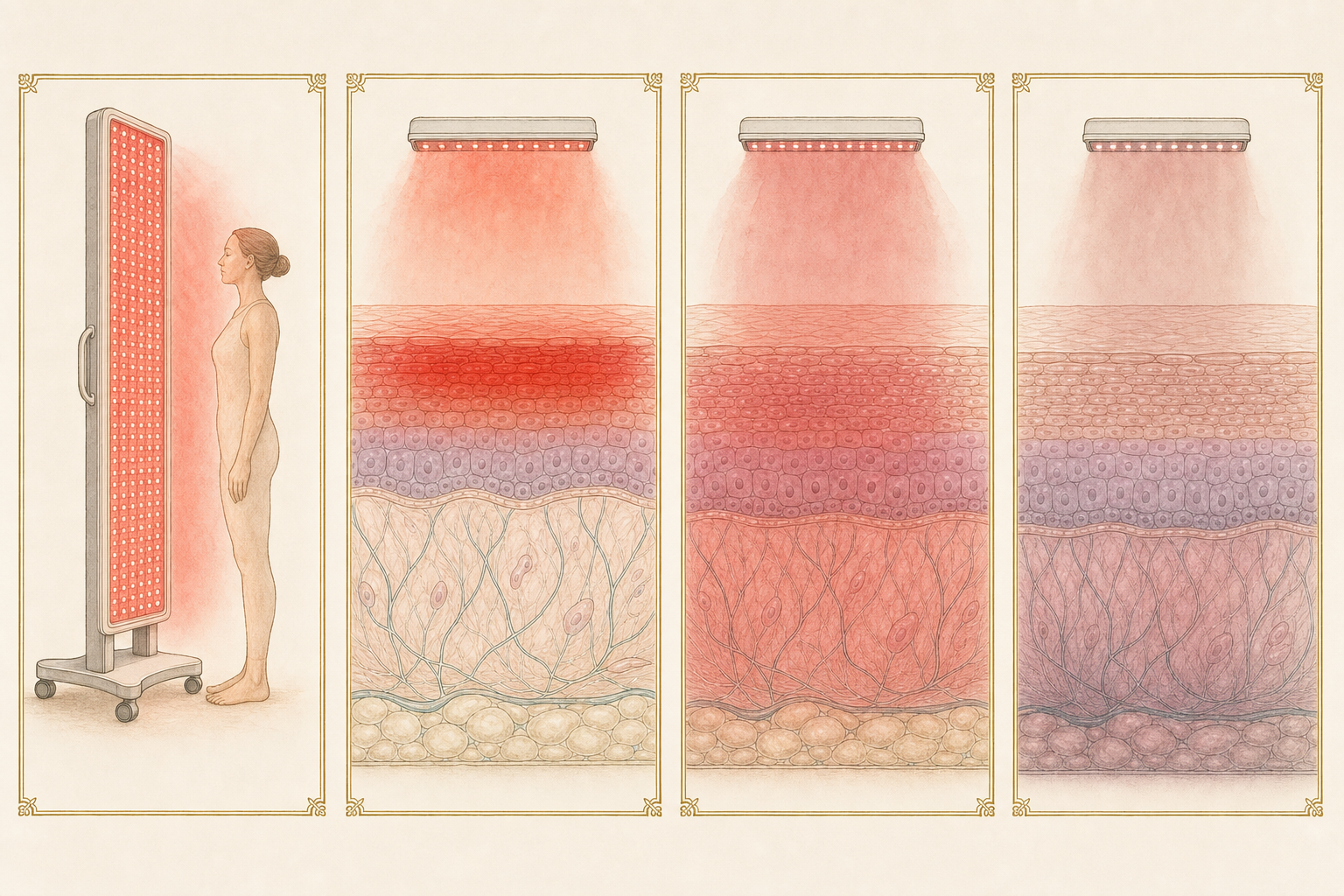
A tall freestanding panel provides broad exposure at the screened treatment distance.
660 nm red · 850 nm near infrared · 940 nm near infrared
How the three-wave full-body light stand works
Idalia uses a freestanding whole-body panel—not a facial LED mask. Its three wavelengths are delivered together as a 3-in-1 red and near-infrared light protocol, subject to screening and the device instructions.
Visible deep-red light sits within the red part of the electromagnetic spectrum.
Near-infrared light is invisible to the eye and has a different absorption pattern from visible red.
This longer near-infrared wavelength adds a third overlapping optical profile to the combined output.
Three numbers do not make a complete protocol
Wavelength describes the light colour or spectral band. Clinical exposure also depends on irradiance at the skin, distance from the stand, illuminated area, treatment time, resulting fluence, pulse or continuous output, skin characteristics and whether the device produces noticeable heat.
What the three wavelengths mean
660 nm
A visible red wavelength widely studied in photobiomodulation research, particularly for superficial skin and repair-related endpoints.
850 nm
An invisible near-infrared wavelength used in research involving deeper soft-tissue exposure as well as skin and recovery contexts.
940 nm
An invisible near-infrared wavelength with a different absorption profile; evidence and dose cannot be borrowed automatically from 850 nm.
3-in-1 output
The Idalia stand combines the three emissions. A combined setting does not prove superiority over a single wavelength without device-specific evidence.
Where Idalia may use it
- As a standalone cosmetic light appointment with exposure selected for comfort and the treatment goal.
- As a screened supportive step after a suitable facial, peel, microneedling or regeneration treatment.
- For face or body positioning when the treatment setup, distance and exposure can be controlled.
- The stand contains 660, 850 and 940 nm light; it contains no blue wavelength.
- This treatment is different from vascular IPL and pulsed-dye laser, which use different technology and target different concerns.
Screening and comfort
Medication and supplements, photosensitivity, eye health, seizure or light-trigger history, active illness, recent procedures, pregnancy considerations and the planned treatment area can change suitability. Eye protection and positioning follow the device instructions. Increasing heat, burning, dizziness or discomfort is a reason to stop and reassess.
More time is not automatically more effective
Photobiomodulation uses dose-dependent biological responses. A longer exposure or shorter distance can change the delivered energy and does not guarantee a better result.
Evidence used for this explainer
Keep this guide
Download the client leaflet
A concise two-page printable version for consultation notes and home-care reminders.
From education to treatment
What is red light therapy and where can I book it in Dudley?
Idalia’s full-body stand combines 660 nm red light with 850 and 940 nm near-infrared light. The wavelength, exposure plan and treatment context are kept clear so LED can be discussed as a standalone wellness session or a selected treatment add-on without exaggerated claims.
Explore Idalia LED therapy