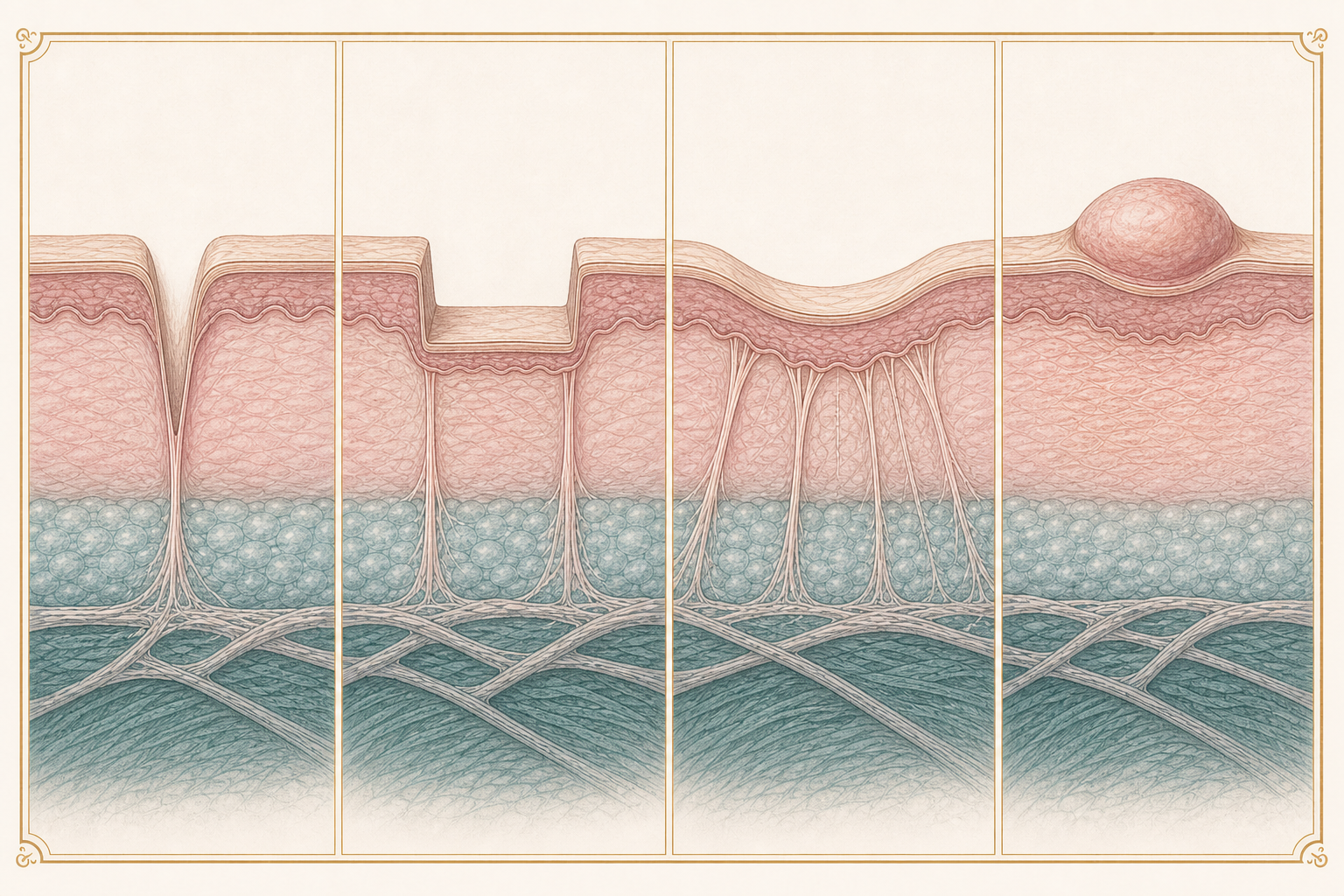
How the named treatments match
| Treatment | Most relevant to | What it cannot do or key caution |
|---|---|---|
| Subcision | Selected tethered rolling or depressed scars where fibrous bands pull the surface down. | It does not resurface ice-pick openings, remove colour or treat raised scars. Bruising, bleeding, haematoma, nerve or vessel injury and incomplete release are possible. |
| Chemical peel or focal chemical technique | Selected superficial texture and post-inflammatory colour; focal TCA CROSS may be used medically for certain narrow deep acne scars. | A general peel does not release a tether or flatten a keloid. Acid strength, depth and skin tone affect burn, pigment and scarring risk; focal high-strength techniques are not DIY treatments. |
| Microneedling | Selected shallow atrophic scars, texture and mature stretch marks. | It cannot release a firm tether by itself. Avoid active infection or inflamed acne; keloid history and pigment risk need careful assessment. |
| RF microneedling | Selected atrophic acne scars, texture and mild laxity where controlled needle-delivered heat may add remodelling. | It is not simply “stronger microneedling”. Device, insulation, depth and energy matter; burns, fat loss, pigment change and new scarring are possible. This remains a future or referral route until Idalia confirms its device and protocol. |
| PMU or medical micropigmentation | Camouflage of a stable, mature, flat scar with a persistent colour difference. | It does not flatten, raise or untether tissue. Colour can shift or fade, repeat sessions may be needed, and infection, allergy or abnormal scarring are possible. Specialist assessment is essential. |
| Silicone, pressure or specialist injection | Raised hypertrophic or keloid scars. | These are different from treatments for depressed scars. Prescription injections and pressure protocols sit with an appropriately qualified medical/scar service. |
| Laser or surgery | Selected redness, texture, deep or complex scars, contracture and cases needing reconstruction. | Downtime and pigment risk vary widely. Excision alone can recur—especially in keloids—so specialist combination planning matters. |
The “5-FU injection” you may have heard about
It is probably intralesional 5-fluorouracil. 5-FU is an anti-metabolite medicine that suppresses fibroblast activity and collagen production; it is used by some specialists for hypertrophic and keloid scars, often with a corticosteroid. It is not a collagen-blocking beauty injection, not a treatment for depressed scars and not suitable for self-use. Protocols vary and risks include injection pain, ulceration, superficial tissue damage, infection and pigment change.
When to pause cosmetic treatment
- The wound is not fully closed or the scar is hot, swollen, painful, draining or rapidly changing.
- There is active acne, eczema, infection or another inflammatory condition across the treatment area.
- There is a personal or strong family history of keloids, poor healing or significant post-inflammatory pigment change.
- The scar restricts movement, follows a major burn, crosses a joint or is causing significant pain or functional difficulty.
A realistic treatment goal
Scar treatment aims to make a scar flatter, softer, more mobile, more comfortable, closer in colour or less noticeable. Complete removal is not a realistic promise, and mixed scars usually improve through a sequence rather than one procedure.
Further reading
- NHS: Scar types, silicone, steroid, laser and camouflage options
- The Christie NHS: Medical tattooing and scar camouflage
- Clinical review of subcision for acne scarring
- Systematic review comparing microneedling and chemical peels for atrophic acne scars
- Systematic review of RF microneedling for acne scars
- Network meta-analysis of specialist intralesional therapies for keloids
- Systematic review of 5-FU in scar management