Decide whether the shape is mainly fat, skin, fluid, muscle separation or anatomy.
Fat · loose skin · bloating · muscle separation · structure
Fat, loose skin or weight loss?
Use this body-area guide to understand what may be creating a lower-abdominal pouch, double chin, upper-arm fullness or another contour concern before choosing a treatment route.
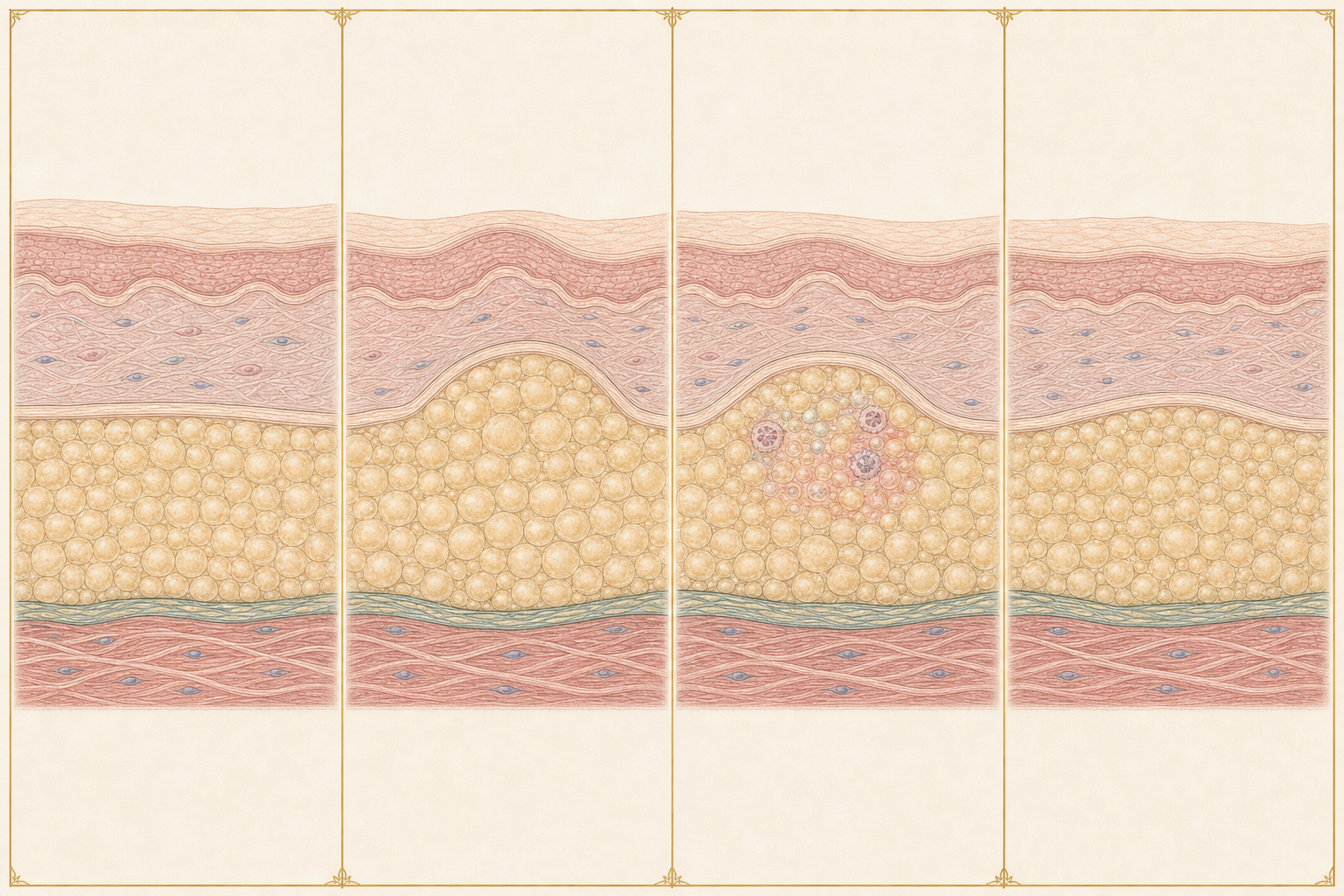
Overall weight change and a small local pocket require different plans.
Reducing volume can reveal or worsen laxity, especially after significant weight loss.
Treat the main cause first, allow it to settle, then reassess what remains.
A five-minute home screen
This is an orientation tool, not a diagnosis. Do not repeatedly press a painful lump or try to inject any area yourself.
1. Gently pinch
A soft, movable fold usually contains subcutaneous fat. Thin, crepey or empty-looking tissue suggests that laxity may be contributing.
2. Compare morning and evening
A shape that changes substantially with meals, bowel movements or the menstrual cycle may involve bloating rather than a fixed fat pocket.
3. Relax, then lightly brace
A central ridge or dome when sitting up can suggest abdominal-wall separation. A local lump that enlarges with coughing needs medical assessment for a possible hernia.
4. Look at the skin surface
Wrinkling, folding or a draped appearance may persist even when the fat layer is small. Cellulite creates dimpling from fat lobules, skin and fibrous bands together.
5. Measure the wider pattern
For most adults with a BMI below 35, waist-to-height ratio helps assess central-fat risk. The NHS advises keeping the waist below half of height.
6. Check for change or symptoms
A new, hard, painful, hot, one-sided or enlarging area is not a cosmetic treatment target until an appropriate clinician has assessed it.
Area-by-area: what can look like fat?
The same visible concern can come from different tissues. A photograph alone may not separate them safely.
| Area | Common possibilities | What changes the plan |
|---|---|---|
| Lower abdomen | Pinchable subcutaneous fat, deeper central fat, bloating, loose skin, diastasis recti or a hernia. | Day-to-day change, a central dome, a cough-related lump, pain, bowel symptoms or gynaecological symptoms need the appropriate medical or physiotherapy route. |
| Double chin | Submental fat, loose skin, chin projection, jaw position, posture or platysmal banding. | Thyroid, salivary-gland or lymph-node swelling must not be treated as fat. Volume reduction can reveal neck laxity. |
| Upper arms and under-arm roll | Subcutaneous fat, skin laxity, muscle shape, normal breast/axillary tissue or a clothing fold. | A discrete armpit lump, breast change or lymph-node concern needs clinical assessment. A thin, loose envelope may need a skin-first or surgical discussion. |
| Bra line, back and flanks | Local fat folds, garment compression, skin laxity and posture. | Broad weight change is different from one stable pocket; changing support garments can reveal how much is positional. |
| Inner or outer thighs and knees | Local fat, cellulite, loose skin, muscle contour, lipedema or swelling. | Painful disproportionate tissue, easy bruising, ankle sparing or persistent swelling warrants medical assessment. Sudden one-sided swelling is urgent. |
| Hips and buttocks | Fat distribution, cellulite, pelvic structure, muscle volume and skin laxity. | Fat reduction does not release cellulite bands and cannot change bone structure. |
Choose the treatment lane—not just a treatment name
| Route | Best match | Important limit |
|---|---|---|
| Overall weight management | A broader change across several areas, raised central-fat risk or a health-led weight goal. | Weight loss cannot choose where fat comes off first. Prescription medicines require a regulated prescriber and legitimate pharmacy; Idalia’s role is non-prescribing support. |
| Local contour assessment | A small, stable, clearly pinchable subcutaneous pocket at or near a stable weight. | It is not a kilogram-loss treatment and cannot reach visceral fat. Product, regulatory status, anatomy and intended area must all be checked. |
| Skin-quality or tightening route | Mild crepiness or laxity with relatively little excess fat. | Ordinary microneedling, RF microneedling, microfocused ultrasound/HIFU and fibre-based laser procedures are not interchangeable and cannot reproduce a surgical lift. |
| Combination sequence | Fat and laxity are both present. | Usually address the dominant volume or weight issue first, allow change to stabilise, then reassess the remaining skin rather than overtreating both at once. |
| Medical, physiotherapy or surgical referral | Hernia, diastasis, gland or lymph-node concern, marked skin excess, lipedema, unexplained swelling or functional symptoms. | A cosmetic procedure may delay the correct diagnosis or produce little benefit. |
Where future RF microneedling and Endolift may overlap
These are principally skin-support and contour procedures—not weight-loss treatments. RF microneedling creates controlled dermal heating through needles and may suit selected mild laxity or texture. Endolift-type procedures place a laser fibre beneath the skin and may affect both tissue contraction and small local fat deposits. Evidence, device settings, training, anatomy, licensing and complication planning are procedure-specific. They should appear as future or referral routes until Idalia has a confirmed device, protocol, competency framework and insurance.
Red flags: pause cosmetic treatment
- A new or enlarging lump, unexplained asymmetry, breast or armpit change, or a hard fixed area.
- A bulge that becomes larger when coughing or straining, especially with pain, vomiting or inability to pass stool or wind.
- Persistent abdominal swelling, unintentional weight loss, blood in the stool, abnormal bleeding or ongoing pelvic symptoms.
- Sudden one-sided leg swelling, redness, heat, chest pain or breathlessness.
Evidence and safety sources
- NHS: BMI, waist-to-height ratio and weight-management routes
- NHS: Bloating and when to seek help
- NHS: Hernia symptoms and urgent warning signs
- NHS: Post-pregnancy abdominal-muscle separation
- MHRA: Regulated GLP-1 medicines and safe supply
- FDA: Safety warning about unapproved fat-dissolving injections
- Systematic review of deoxycholic acid for submental fat
- Systematic review of RF microneedling indications and evidence limits
- Systematic review of 1470 nm fibre-based Endolift procedures
Quick reference
Download the localised-fat leaflet
The printable leaflet focuses on local subcutaneous fat; this web guide contains the fuller body-shape and weight-loss selector.
From education to treatment
What is the best treatment for stubborn fat or loose skin in Dudley?
A small pinchable fat pocket is different from general weight change, bloating, cellulite or loose skin. Idalia keeps those goals separate before discussing double-chin treatment, localised fat dissolving, body contouring or a non-treatment alternative.
Explore body-contouring options